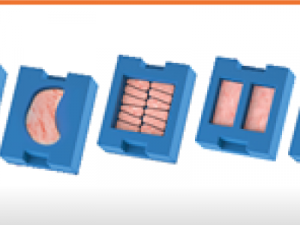
Our block sawing technology has long been the industry standard to transform frozen blocks into uniform portions. This proven method delivers consistency and efficiency, serving processors reliably for decades: a highly automated and safe process, with only of 2% of product lost to sawdust and trimmings. Still, 2% loss add up to significant amounts for processors, so we took to the challenge to develop a process that achieves 100% yield. We are proud to announce that we have succeeded. Let us introduce “Flake Shaping”. Nienstedt’s flake shaping technology transforms the processing sequence. Rather than sawing frozen blocks directly into finished portions, the process converts blocks into flakes that can then be shaped into three-dimensional products with complex contours. This technology has remarkable benefits, not only from an economic yield perspective, but from a product development and consumer experience perspective, as well. 100% material utilization: The flaking process eliminates saw dust and trim waste, converting the entire frozen block into usable product. Species blending capability: Different fish varieties can be combined within a single product, enabling processors to optimize for taste profiles, nutritional targets, or cost management while maintaining consistent quality. Think B-grade blocks or IQF inputs. Ingredient integration: Vegetables, herbs, spices, and other components can be incorporated throughout the product matrix, not merely applied as coatings or toppings. This creates genuine new (hybrid) product categories with high appeal to consumers. The complete process Flake shaping integrates into existing frozen fish processing operations, working alongside rather than replacing established methods: Step 1 – Block preparation: Frozen fish blocks enter the flaking system. If ingredient integration is desired, vegetables or other components are prepared in parallel. Step 2 – Flaking: The frozen block is processed into flakes of controlled size. This mechanical transformation maintains the fibrous structure of the fish muscle tissue. Step 3 – Blending (optional): If creating multi-species or ingredient-enhanced products, flakes from different sources are precisely blended at this stage. Ratios can be adjusted to meet specific product specifications or respond to raw material availability. Step 4 – Shaping: The flake mixture is shaped into final product forms—whether nuggets, patties, strips, or entirely novel geometries. Step 5 – Downstream processing: Shaped products proceed to standard breading, battering, cooking, and freezing operations that processors already use for conventional products. Manufacturers can add flake shaping capability without abandoning existing infrastructure or processes. Traditional block sawing continues handling applications where it excels, while flake shaping addresses opportunities that require different capabilities.